

The Collector’s Guide to Limited Edition Relief Prints: Fine Art, Editioning, and Archival Integrity
For centuries, printmaking has occupied a unique space in fine art—a medium bridging architectural precision, master craftsmanship, and expressive physical depth. As an artist and printmaker working with hand-carved, hand-pulled relief prints, I am frequently asked by discerning collectors: What distinguishes an original limited edition relief print from a modern digital copy? How does traditional hand-pulled editioning preserve exclusivity and value? And what should a collector look for when investing in works on paper? In a modern landscape saturated with high-resolution digital reproductions and commercial giclée posters, understanding true archival craft is essential.
Whether you are building a fine art collection, seeking original pieces for an interior, or looking to understand the nuanced provenance of relief printmaking, this guide offers an in-depth breakdown of original relief prints, traditional editioning conventions, archival paper integrity, and long-term care for fine art prints.
1. Original Relief Print vs. Digital Reproduction: Understanding the Difference
To appreciate the value of a fine art relief print, a collector must first navigate the distinction between an original print and a reproduction. In my case, all of my own original relief linocut prints are hand burnished, which is to say, I use a traditional wooden baren to rub the back of the paper, in order to transfer ink. I do not use any mechanical press. The comparison table below reflects this. Indeed, this blog largely refers to my own preferred methods of creation.
| Feature | Original Relief Print | Digital Giclée |
|---|---|---|
| Primary Artwork | The printed sheet itself | The original image |
| Production Method | Hand-carved & burnished | Commercial inkjet |
| Surface Texture | Embossed, tactile ink | Flat ink on paper |
| Material Longevity | Archival oil & cotton | Variable dyes |
| Exclusivity | Strict limited runs | Unlimited re-runs |
What Is a Digital Giclée?
A giclée (or digital print) is a high-resolution inkjet photograph or scan of a pre-existing artwork. The digital printer sprays micro-droplets of ink onto paper, reproducing a flat visual copy of a painting, drawing, relief or intaglio print. While high-quality giclées serve well for poster distribution, the printed sheet itself is not a primary artwork—it is a photo-mechanical duplicate.
What Is an Original Relief Print?
An original relief print (such as a hand-cut linocut or woodcut) is not a copy of an artwork; it is the primary artwork itself.
The process begins with a blank linoleum or wooden block or sheet. The artist hand-carves away negative space using specialized gouges, leaving raised relief surfaces that carry the composition. Archival oil-based relief ink is rolled onto these raised surfaces with a brayer. Finally, a sheet of archival paper is laid over the block and hand-burnished or passed through a press, transferring the ink directly into the fibers under immense physical pressure.
When you hold an original relief print, you are holding the direct physical imprint of the carved block. The paper bears a distinct tactile embossment—a subtle three-dimensional relief created by the pressure of the block pushing into heavy cotton rag paper.
Why Surface Tactility Matters to Collectors
Unlike flat inkjet prints, an original hand-pulled linocut possesses a unique surface topography:
Tactile Embossment: The raised relief areas push into the damp paper fibers, creating a subtle debossed outline around carved passages.
Satin Oil Finish: Professional relief inks dry with a rich, velvety satin texture rather than the flat sheen of inkjet toners.
Micro-Variations: Because each impression is pulled by hand using manual burnishing tools (such as wooden barens), subtle nuances in ink transfer create tiny, hand-crafted variations across an edition. These are not flaws—they are the unmistakable mark of human creation and visual provenance.
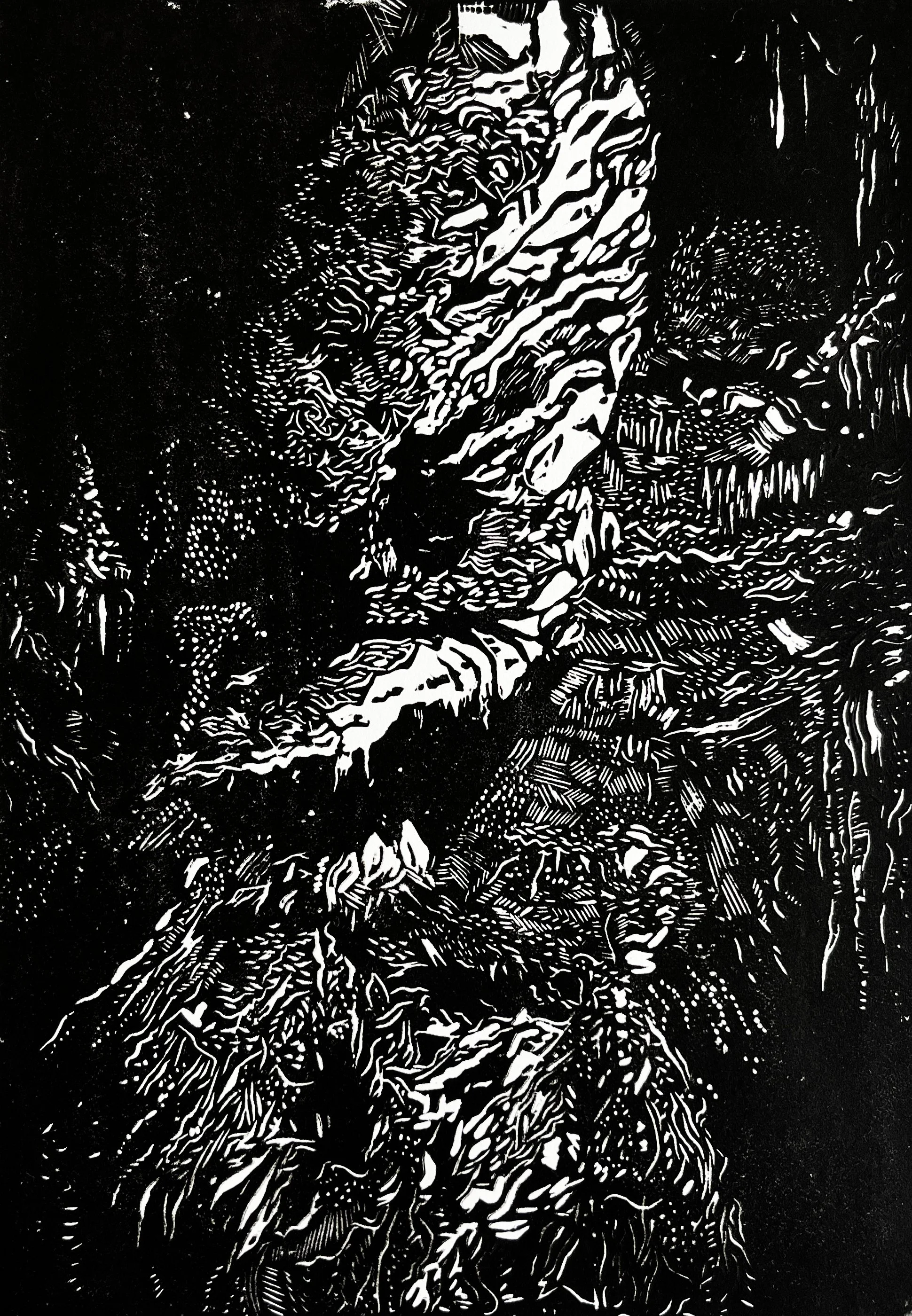
This piece pushes deeper into the abstract, subterranean landscapes of Vietnam’s massive cave networks. This original monochrome linocut presents a brilliant contrast of dense, organic textures, using hyper-detailed, rhythmic marks to capture the tactile reality of ancient, eroded stone and echoing hollows. It also explores the ancient growth of stalactites. The composition captures these mineral structures as they hang from invisible ceilings, frozen in a silent, centuries-long descent toward one another inside the echoing hollows.
Hand-carved with rigorous physical precision and burnished entirely by hand with a wooden baren, the work rejects mechanical intervention to ensure the heavy archival ink retains a rich, varied depth on the surface. The composition acts as a conceptual "Anchor of Attention," capturing the friction between geological vastness and intimate human memory. By translating the slow, meditative hours spent at the carving block into a complex topography of light and shadow, the piece explores how personal heritage adapts and anchors itself when surrounded by an immense, unfamiliar environment.
2026
This is a linocut printed on lovely Arnhem 1618 white 245gsm paper.
From a limited edition of 25
Size: 19.2 cm x 27.5 cm (7.559 in x 10.827 in)
The work is signed and numbered by the artist.
Each linocut print will not be identical to the next, due to the nature of the printing process, but this adds to its unique quality.
2. Deciphering Fine Art Print Notation: Editioning, Proofs, and Numbers
When reviewing a hand-pulled print in a gallery setting or online studio catalog, you will notice pencil inscriptions along the bottom margin below the image area. This fine art notation is a standardized system created to guarantee authenticity, edition limits, and collector transparency.
STANDARD MARGIN SIGNATURE LAYOUT
[Edition No.]
[Title]
[Signature]
The Edition Number (1/N)
The fraction on the left margin (e.g., 3/15) indicates the specific impression number and the total edition size.
Numerator (Top Number): The individual sheet number within the run.
Denominator (Bottom Number): The absolute maximum number of signed and numbered prints in that edition.
Small edition sizes (typically between 5 and 25 impressions for hand-pulled relief prints) preserve rarity and long-term exclusivity. Once an edition of 25 is fully pulled and signed, the relief block is permanently canceled or retired, ensuring no further prints can ever be created from that block.
Artist’s Proofs (A/P)
Before or during the main editioning run, an artist pulls a limited number of Artist’s Proofs (marked A/P or AP). Historically, these were pulled for the artist’s private collection or studio archive. Standard gallery practice dictates that A/P runs do not exceed 10% of the total edition size. Because of their close connection to the artist's studio testing process, Artist’s Proofs are often highly sought after by seasoned collectors.
Trial Proofs (T/P) and State Proofs
During the carving process, an artist will pull Trial Proofs (T/P) to check the progress of shadow lines, light passages, or structural textures. These working proofs show the evolution of the block before the carving is finalized. They are often unique single impressions (1/1) and offer fascinating historical insight into the artist's studio development.
Monoprints, Variable Editions (E/V), and Special Works
While a standard edition strives for consistency across impressions, some contemporary relief practices intentionally introduce unique variables into each pull:
Edition Variable (E/V): Indicates that the core relief block remains constant, but the paper background, ink coloration, or underlying surface differs significantly across impressions.
Suminagashi Linocuts: An advanced technique where traditional Japanese floating-ink paper marbling (Suminagashi) is combined with a hand-carved relief print. Because floating marbling patterns on water can never be duplicated, every sheet in a E/V series is a genuine 1/1 original artwork layered beneath the carved relief impression.
3. The Materials of Permanence: Archival Paper, Inks, and Deckled Edges
The long-term value and structural integrity of a fine art print depend entirely on the chemistry of its raw materials. Commercial prints made on wood-pulp paper with water-based dyes begin to yellow, warp, and fade within a few years of light exposure. Fine art relief prints, by contrast, are engineered for century-long permanence using museum-grade archival components.
100% Cotton Rag Paper vs. Wood-Pulp Paper
Museums and international art galleries require prints to be executed on acid-free, 100% cotton paper.
Wood-Pulp Paper (Standard): Contains lignin, an organic compound found in trees. Over time, lignin reacts with ambient oxygen and ambient light, turning the paper yellow, brittle, and acidic (a process visible in old newspapers).
100% Cotton Paper (Archival): Crafted from pure cotton fibers (linters), these papers are naturally acid-free and pH-neutral. Cotton fibers are long and flexible, allowing them to absorb heavy physical pressure, deep ink saturation, and environmental humidity shifts without degrading.
Premium printmaking papers—such as Fabriano Rosaspina, Somerset and 245gsm Arnhem archival rag—provide a tactile weight and soft, natural surface texture that elevates the printed image.
Every impression is individually hand-pulled using traditional burnishing techniques and archival materials. For a deeper look at the process, studio tools and materials involved, read my Linocut Process Guide.
“Unlike digital reproductions, every impression in a hand-pulled relief edition is individually hand-burnished on 100% cotton rag paper. Subtle organic variations in ink pressure and paper deckle ensure that while the edition size is fixed, every print remains a distinct physical object.”
Deckled Edges
Many hand-pulled relief prints feature deckled edges—soft, feather-like natural edges on the paper sheet created during traditional paper manufacturing. Far from being a trimming defect, deckled edges are a prized visual characteristic of hand-made paper that collectors frequently highlight using specialized float-framing techniques.
Paper Watermarks: The Embedded Seal of Provenance
Beyond surface texture and deckled edges, discerning collectors often look for the subtle presence of a watermark embedded within the paper fibers. A watermark is a translucent design, emblem, or maker's mark created during the traditional paper-molding process by altering the fiber density in specific areas of the sheet. When held up to a light source, the mark illuminates softly through the paper, revealing the heritage and authenticity of the mill that produced it.
Historically, watermarks served as a mark of quality control for European paper mills, guaranteeing purity of materials, rag content, and weight. In contemporary fine art printmaking, the inclusion of a recognized watermark—from premier mills like Fabriano, Arches, or Rives—offers immediate visual verification that the artwork is pulled on genuine, 100% cotton archival stock rather than mass-market wood-pulp paper.
For collectors, watermarks add an extra layer of tactile provenance and tactile luxury to a limited edition print:
Authenticity & Traceability: A visible watermark acts as a permanent, non-reproducible signature within the paper itself that cannot be faked by digital printing or mechanical reproduction.
Orientation & Front-Facing Proof: Traditionally, paper mills place watermarks so they read correctly from the front side of the sheet. In fine art editioning, this serves as an additional check that the print was pulled on the primary, grain-aligned surface of the paper.
Float Framing Feature: When float-mounting a relief print, leaving the watermark subtly visible near the deckled margin highlights the historic craft behind the physical sheet, elevating the artwork's presence on a collector's wall.
Oil-Based Lightfast Inks
The choice of ink dictates color vibrancy and long-term resistance to fading under ambient room light. Fine art printmakers utilize high-pigment, archival oil-based relief inks designed to withstand decades of exposure without shifts in tone or value.
Top-Tier Lightfastness Ratings: Professional relief inks are evaluated using international ASTM lightfastness standards. For example, my primary studio ink of choice—Speedball Super Graphic Black Relief Ink—carries an official Rating I (Excellent) lightfastness classification. This rating guarantees that the deep, rich black passages will maintain their visual strength and saturation across generations without fading or turning brown under display lighting.
Tactile Saturation & Velvet Finish: Unlike water-based pigments that can look flat or chalky, professional oil-based inks bind deeply into the cotton fibers rather than sitting as a brittle film on top. This creates a permanent, moisture-resistant bond with a signature satin-velvet sheen that collectors appreciate up close.
4. How to Frame and Preserve Relief Art: The Collector’s Checklist
Acquiring a fine art relief print is only the first step; proper mounting and framing ensure that the artwork remains protected against environmental atmospheric changes, UV radiation, and physical pressure for generations.
For detailed standards on environmental controls and housing works on paper, refer to the Library of Congress Preservation Guidelines.
MUSEUM-GRADE FRAMING CROSS-SECTION
(Hinged with Acid-Free Japanese Paper Tape)
1. Always Use Acid-Free Museum Board (Matting)
Never allow the printed image or paper margin to come into direct contact with standard cardboard or wood-based backing boards, which leach acid into the paper over time (causing "mat burn" borders). Always specify 100% acid-free cotton rag matboard.
2. Float Framing vs. Window Matting
Collectors have two distinct, elegant choices when framing relief prints:
Float Mounting (Recommended for Deckled Edges): The print is elevated slightly off a neutral museum-board backing sheet, allowing the full edges—including the natural deckle and paper texture—to remain completely visible inside the frame.
Window Matting: An acid-free matboard window covers the outer white margins while framing the image. Ensure the mat window stays slightly outside the pencil signature and edition notation so the provenance remains fully readable.
To ensure long-term preservation, work with a professional framer who adheres to the conservation levels outlined by the Fine Art Trade Guild.
3. Maintain an Air Gap (Never Glass-to-Print)
The printed surface of a relief print should never touch the frame’s glass or acrylic lens directly. Changes in humidity can cause the ink or cotton paper to adhere to the glass, causing permanent damage. A window mat or internal wood frame spacer creates a essential air gap between the glazing and the artwork.
4. Choose UV-Filtering Glazing
Standard window glass blocks only a fraction of ultraviolet light. To protect oil-based inks and archival paper from long-term light damage, choose Conservation Clear Glass or Museum-Grade UV Acrylic (which blocks over 99% of harmful UV rays).
“Works on paper thrive in controlled micro-climates. To maintain paper tension and prevent ink degradation, display prints in spaces held between 40–55% relative humidity, framed behind 99% UV-filtering glass or museum acrylic.”
5. Archival Hinging (Never Tape or Glue)
When mounting the print to its backing board, insist that your framer uses archival Japanese wheat-starch hinges or acid-free linen tape. Never permit self-adhesive packing tape, masking tape, or dry-mount adhesives to touch an original print, as these leave permanent chemical stains and ruin collector value.
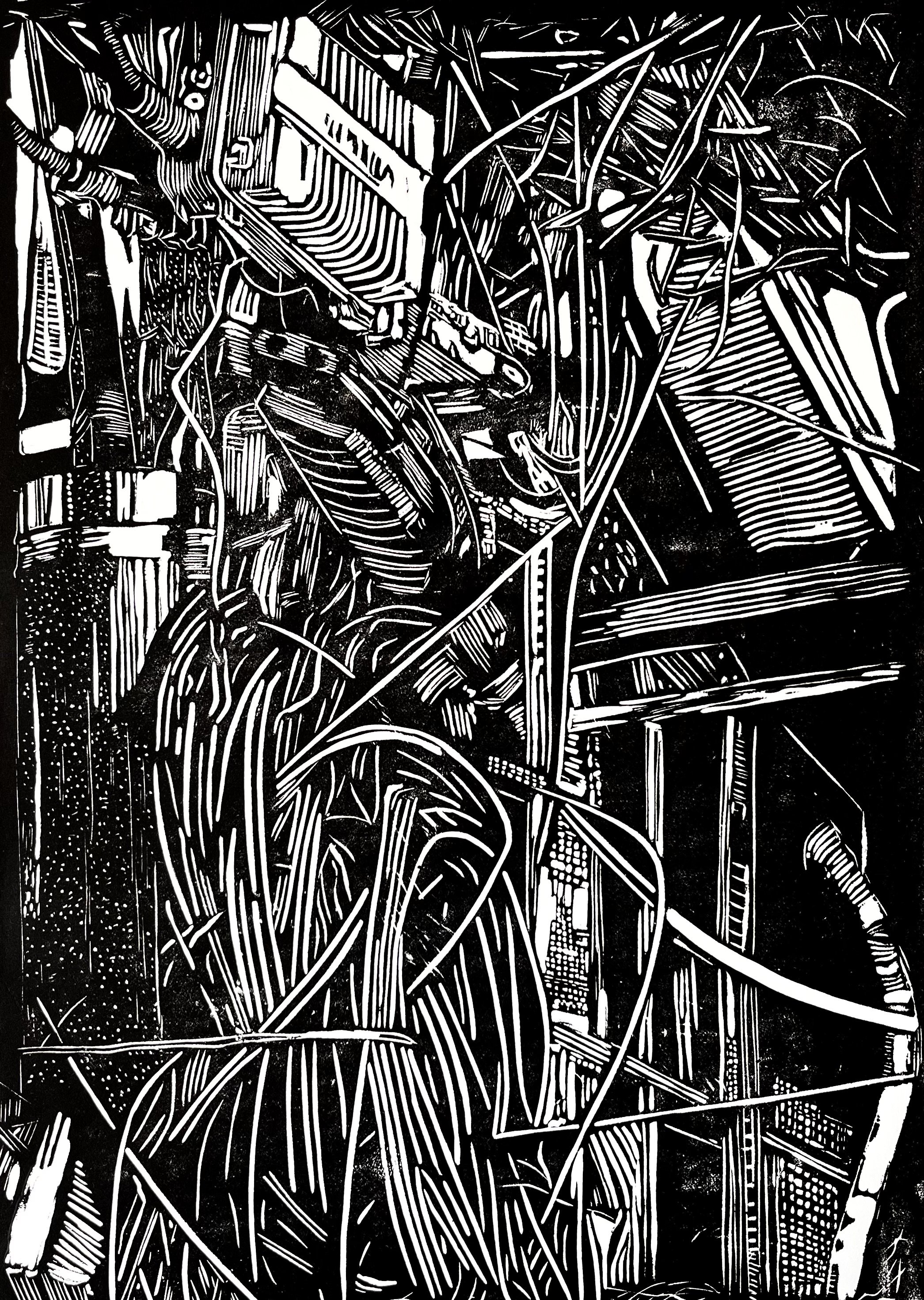
Tangled Wires captures the chaotic rhythm and tactile energy of Vietnam’s iconic overhead power grid. Suspended above urban streets and alleyways, these dense, black-and-white networks—often called "spiderwebs" (mạng nhện)—form a living canopy of infrastructure.
This original linocut relief print transforms daily utility into a powerful exploration of spatial tension and human connectivity. Every line in the composition is hand-carved into hessian-backed linoleum and hand-pulled without a mechanical press, using a wooden baren to transfer high-density oil ink onto heavy archival printmaking paper.
The resulting impression highlights raw gouge marks, deep contrast, and rich surface textures, offering a striking focal point for contemporary art collectors, printmaking enthusiasts, and lovers of urban architecture.
2026
This is a linocut printed on lovely Arnhem 1618 245gsm paper.
From a limited edition of 12
Size: 31 cm x 44 cm (12.2 in × 17. 3 in)
The work is signed and numbered by the artist.
Each linocut print will not be identical to the next, due to the nature of the printing process, but this adds to its unique quality.
6. Condition Reports, Storage, and Handling Studio Etiquette
Beyond framing, how a collector stores unframed prints before they reach the framer significantly impacts their long-term condition and market value.
Handling Studio Etiquette
Always Wear Cotton Gloves: Bare hands transfer natural skin oils and moisture directly onto raw 100% cotton rag paper. Over time, these oil deposits react with atmospheric dust and air pollutants, causing subtle fingerprint stains or yellowing.
Support the Sheet with Two Hands: Never lift an unframed print by a single corner. Heavy archival paper stocks (such as 245gsm rag) can develop permanent paper creases or stress fractures under their own weight if unsupported.
Flat Portfolio Storage (Never Long-Term Tube Rolling)
Short-Term Transit: Heavy cotton relief prints can be gently rolled into large-diameter postal tubes using protective tissue interleaving for shipping transit.
Long-Term Storage: Upon arrival, unroll the artwork immediately and allow it to relax flat inside a Solander box, acid-free portfolio folder, or flat-file drawer. Storing heavy paper rolled for months sets a permanent curl in the cotton fibers that makes framing and float-mounting difficult.
Acid-Free Interleaving: Always place a sheet of pH-neutral glassine paper or archival tissue between stacked prints to prevent the oil-based ink of one impression from transferring onto the unprinted white margin of the sheet above it.
Note on Shipping & Transit: While wide-diameter postal tubes are frequently used for international courier transit, heavy cotton rag prints should ideally be shipped flat whenever possible. If tube shipping is necessary due to size, prints must be rolled loosely (art facing outwards over glassine interleaving) inside a wide 4-inch or 6-inch tube, and immediately unboxed and laid flat upon arrival.
Requesting a Condition Report
When acquiring original works online or through galleries, request a Condition Report. A formal studio condition report verifies that the paper sheet has zero corner bumps, edge foxing (humidity spots), or surface abrasions prior to dispatch, ensuring peace of mind for high-value art investments.
UNFRAMED ART STORAGE & TRANSIT BEST PRACTICES
✓ DO:
- Ship flat between rigid double-wall corrugated boards whenever possible.
- Store flat in archival Solander boxes or museum portfolios.
- Interleave sheets with acid-free glassine paper.
- Wear clean white cotton gloves when handling raw sheets.
✕ DO NOT:
- Roll prints tightly inside narrow 2-inch or 3-inch tubes.
- Leave cotton rag prints rolled in tubes for longer than transit requires.
- Touch printed ink or raw cotton paper with bare, oily fingers.
- Use standard tape, paper clips, or non-archival adhesives.
5. Acquistion and Insurance
Fine Art Insurance & Estate Archiving
A fine art collection is both a cultural passion and a financial asset that requires proactive legal and logistical protection:
Dedicated Fine Art Insurance Riders: Standard homeowners policies often cap coverage for works on paper under general personal property limits. Schedule valuable limited editions under a dedicated Fine Art Rider covering "agreed value" against transit damage, environmental incidents, or loss.
Digital Inventory & Fireproof Storage: Maintain a digital collection archive containing high-resolution photography, purchase invoices, and condition reports. Always store original physical Certificates of Authenticity (COAs) inside a fireproof safe, stored separately from the framed artworks themselves.
Acquisition Strategy: Primary vs. Secondary Market
When expanding a fine art collection, understanding where and how you acquire works impacts both provenance security and studio relationships:
Primary Market (Direct Studio & Representing Gallery Purchases): Purchasing directly from an artist’s studio or primary representing gallery guarantees 100%$ indisputable provenance, directly supports the artist’s ongoing studio practice, and often provides early access to coveted low edition numbers (such as 1/12 or 2/12).
Secondary Market (Auctions & Private Resale): Acquiring works through auction houses or secondary dealers requires heightened due diligence. Collectors should always request a detailed Condition Report prior to acquisition to verify the sheet has not suffered light staining, acid transfer from non-archival backings, or trimmed deckled edges.
Understanding editioning conventions and provenance is central to collecting original prints, as outlined by international print authorities like the IFPDA.
Institutional Validation & Acquiring Works Directly
When building a fine art collection, secondary market transparency and institutional recognition are essential. An artist’s representation on global fine art platforms like Artsy provides collectors with independent, third-party validation. It confirms that the studio's editioning standards, archival practices, and pricing integrity align with international gallery benchmarks.
While an Artsy profile offers peace of mind regarding market valuation and authenticity, collecting works directly from the studio online shop offers a distinct advantage. When you acquire a print directly from the studio:
Direct Provenance: Your impression is logged directly into the primary studio archives alongside its Certificate of Authenticity, creating an uninterrupted chain of ownership.
First-Access Editions: Purchasing directly gives collectors priority access to lower edition numbers or unique hybrid proofs before they are distributed to third-party art fairs or platform listings.
Studio Consultation & Quality Control: Every work is prepared, inspected, and packaged directly by the artist, ensuring museum-standard handling from the drying rack to your wall.
Whether discovered through Artsy or acquired directly from the studio, every piece is held to the exact same rigorous editioning and conservation standards.
6. Building a Fine Art Collection
Building a meaningful art collection is both an aesthetic journey and a preservation of human craft. When evaluating a new relief print for your home, executive office, or gallery collection, keep this essential checklist in mind:
COLLECTOR EVALUATION CHECKLIST
- [✓] Hand-Pulled Provenance: Is the print a genuine relief impression, not a digital giclée?
- [✓] Archival Materials: Is it printed on 100% acid-free cotton paper with lightfast oil-based ink?
- [✓] Clear Edition Limits: Is the total edition size clearly stated, signed, and numbered in pencil?
- [✓] Physical Tactility: Can you feel or see the subtle relief embossment on the cotton paper sheet?
- [✓] Studio Documentation: Does the print come accompanied by a formal Certificate of Authenticity?
Studio Documentation & Certificates of Authenticity
A primary fine art print should always arrive with clear documentation signed by the artist. A formal Certificate of Authenticity (COA) verifies:
Artwork Title and Creation Date
Medium and Specific Execution Technique (e.g., Hand-Pulled Linocut)
Paper Stock Brand and Weight (e.g., Arnhem 1618 Warm White, 245gsm)
Exact Edition Number and Total Run Limit
Artist’s Signature and Studio Location
7. Interior Curation: Displaying Relief Art in Contemporary Spaces
CURATION & INTERIOR PLACEMENT
| Architectural Style | Recommended Framing & Display Strategy |
|---|---|
| Brutalist / Concrete | Float-mounted in thin matte-black frames to mirror raw structural textures. |
| Minimalist Residential | Wide 4-ply white cotton mats in natural oak frames to let the paper deckle breathe. |
| Industrial Loft | Triptych or modular grouping over exposed brick or corrugated feature walls. |
8. Available works in my portfolio
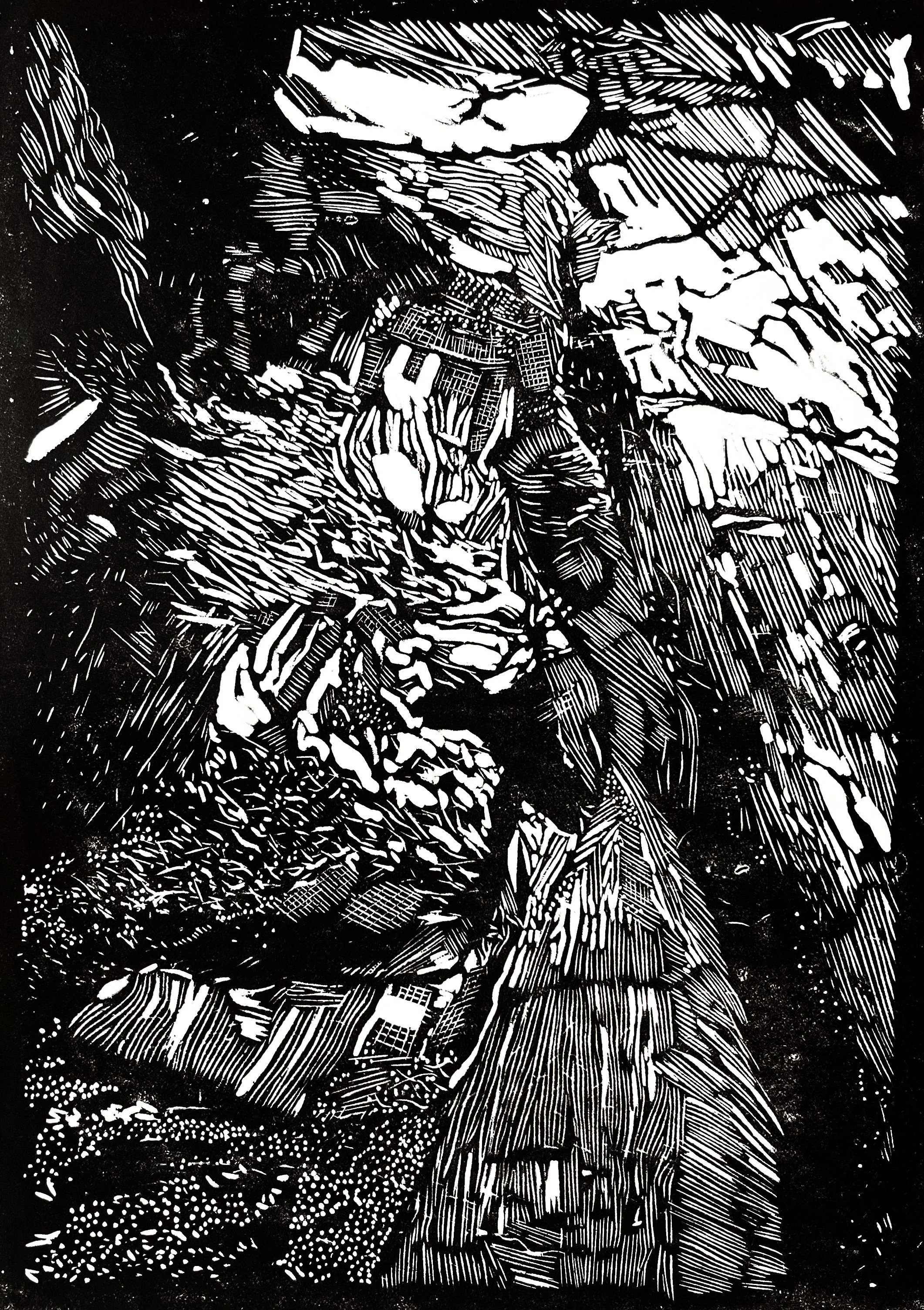
Acquire available works directly through the Artist
Every relief print in my studio is hand-carved, manually burnished, and individually pulled onto museum-grade 100% cotton rag paper. My limited edition linocuts are created for collectors who value tactile depth, archival permanence, and authentic hand-crafted provenance.
Artist Profile: Mark James Murphy
From the industrial heartlands of Sunderland to the vibrant, sun-drenched coastal alleys of Vũng Tàu, Vietnam, my journey as a printmaker has always been defined by a search for "intentional resistance." As a self-taught contemporary artist, I specialize in the slow, meditative craft of hand-carved and hand-pulled linocut prints.
My work is an exploration of the "anchor of attention"—using the physical tension of the carving tool to bridge the gap between my British heritage and the pulsing energy of Southeast Asia. Whether capturing the grit of an urban landscape or the fluid soul of a Suminagashi-hybrid portrait, my practice is a commitment to the deliberate over the digital. Each piece in my studio is produced in strictly limited editions, ensuring that the raw, physical connection between the block and the paper is preserved for every collector.
